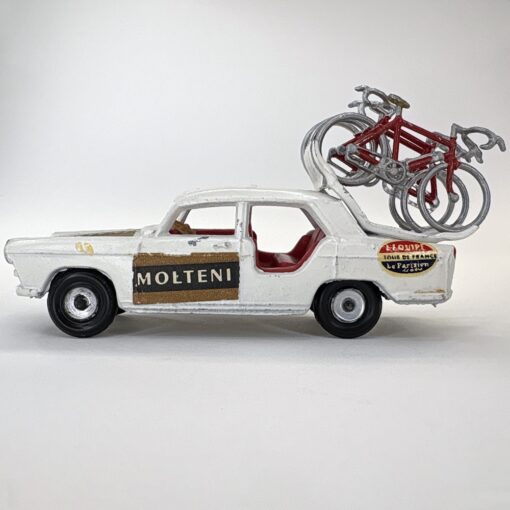
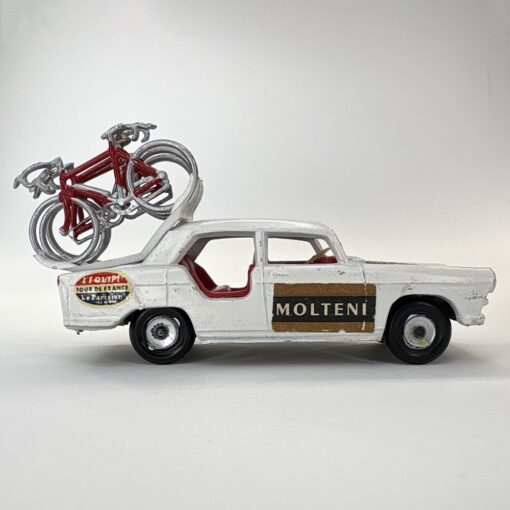
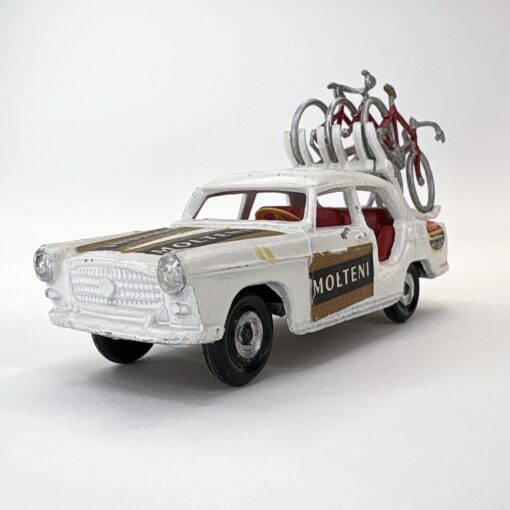
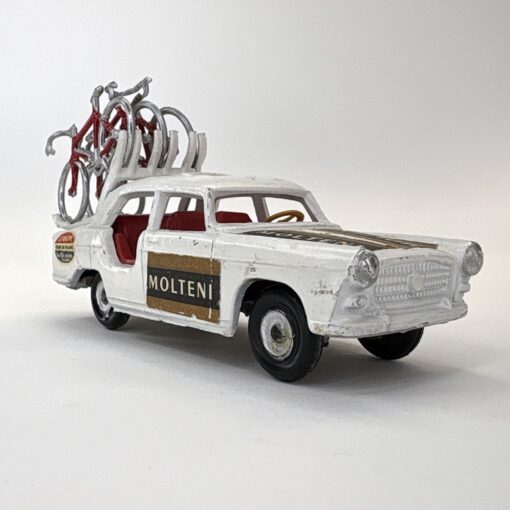
This Molteni Team car is a beauty! Check out the cut-out back doors, steering wheel, and bike-filled rack, all ready to roll for the Tour. This car would be a fantastic addition to any desktop peloton. The Molteni Cycling Team was one of the defining squads of postwar professional cycling. Sponsored by the Italian salami company from Arcore, near Milan, Molteni raced from 1958 through 1976 and became legendary after Eddy Merckx joined in 1971. During the Molteni years, Merckx won the Tour de France in 1971, 1972, and 1974, the Giro d’Italia in 1972, 1973, and 1974, and the Vuelta a España in 1973, along with major Classics and stage races. The team’s leading riders included Eddy Merckx, Gianni Motta, Marino Basso, Rudi Altig, Peter Post, Michelle Dancelli, Joseph Bruyère, Roger Swerts, Herman Van Springel, and Franco Balmamion. With its brown and orange kit, Molteni remains one of cycling’s most instantly recognizable and historically important teams. Salza, a French company founded by Victor Salza in 1947, became renowned among cycling fans for producing detailed model race vehicles and cyclists. Victor Salza, born in Italy in 1915, was passionate about accuracy and took meticulous steps to ensure his figurines were as realistic as possible. To achieve this, he would attend races in person to photograph the cyclists and vehicles to replicate them precisely. Initially, the figurines were metal, but later transitioned to plastic. The cyclists were depicted in various dynamic poses, such as raising their arms in victory, carrying flowers after a win, grabbing a musette, or drinking from a water bottle. Salza also created figurines representing other characters involved in cycling races, such as police officers (gendarmes), motorcycles, cameramen, team support crew, and follow cars. In the early days, Salza’s cyclists were relatively simple, flat silhouettes. However, by the early 1950s, the company introduced more complex 3D figurines. These models initially sported national or regional jerseys, with advertising jerseys not appearing until 1962. The figurines were often sold individually or in sets, sometimes including scenic backgrounds and additional characters to complete the scene. Salza’s attention to detail and realistic depictions have made these collectibles cherished pieces in cycling memorabilia. Sadly, the Salza factory closed for good in 1978, but these charming toys live on. Maker: Salza Diecast Metal, 1/43 Scale Size: 5 1/4 inches long (13.5 cm) This is a one-of-a-kind item; please look carefully at the photos to determine the condition.
Related products
-
Personalised Tour de France Camera Car, Renault 16, Corgi Toys, 1/43 Scale, c. late 1960s $ 90.88 Select options This product has multiple variants. The options may be chosen on the product page
-
Glassware 1968 Tour de France, Race Used Moto Plaque, Race Winner Jan Janssen $ 92.98 Select options This product has multiple variants. The options may be chosen on the product page