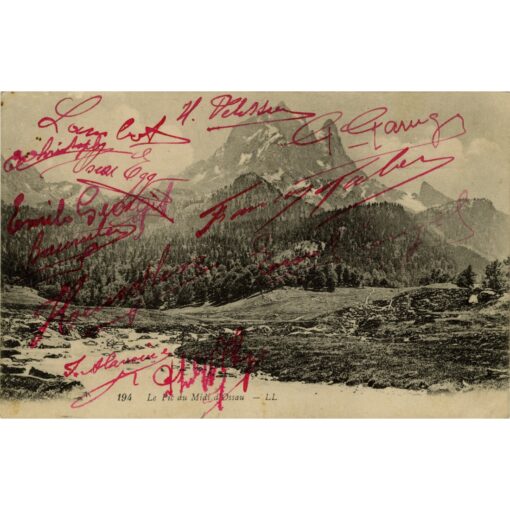
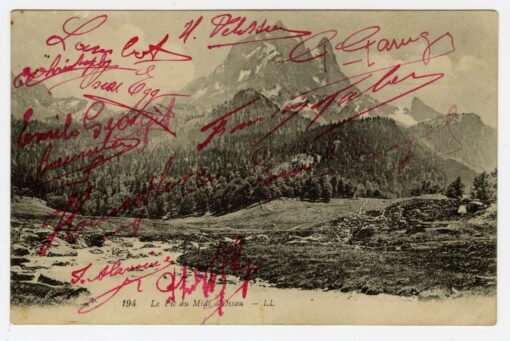
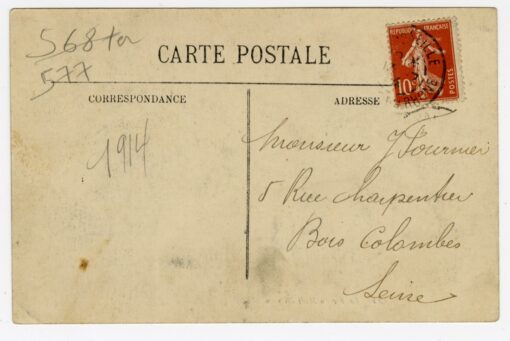
1914 Tour de France Postcard – Signed by Racing Legends – Thys, Garrigou, Faber, Lambot, Pelissier, Christophe, Georget, Alavoine, Egg & Heusghem
$ 91.73
Description Legends of Early Cycling – François Faber was the first foreign winner of the Tour de France, taking overall victory in 1909, and remains one of the most imposing figures of the sport’s early years. Known for his enormous strength and long solo efforts, Faber won five consecutive stages in the 1909 Tour, a record that still stands, and became a symbol of the brutal endurance demanded by racing before the First World War. He was killed in 1915 while serving with the French Foreign Legion, giving his autograph an added poignancy on a card dated to the eve of war. Gustave Garrigou was one of the finest all-round riders of the prewar era and winner of the 1911 Tour de France. Light enough to excel in the mountains yet strong across the long, punishing flat stages, Garrigou was a model of consistency, finishing on the Tour podium multiple times and winning stages across several editions. His career also included major victories beyond the Tour, including the French national road championship, Paris-Brussels, Milan-San Remo, and the Giro di Lombardia. Philippe Thys was the winner of the 1914 Tour de France and later became the first rider to win the Tour three times, with victories in 1913, 1914, and 1920. His 1914 victory was hard fought, with Henri Pélissier pushing him closely before Thys secured the race. Thys’s career was interrupted by the First World War, but even with that disruption he emerged as one of the greatest stage racers of the early twentieth century. Firmin Lambot won the Tour de France twice, in 1919 and 1922, and was already a major rider by the time this card was signed. In the 1914 Tour, he won the great Bayonne to Luchon mountain stage, a 326-kilometer Pyrenean epic over the Aubisque, Tourmalet, Aspin, and Peyresourde. Lambot’s later Tour victories placed him among Belgium’s most important early champions, and his 1922 win made him the oldest Tour de France winner, a distinction he still holds. Henri Pélissier was one of France’s most brilliant and fiery champions, later winning the 1923 Tour de France and becoming one of the defining personalities of the postwar racing era. At the 1914 Tour, he finished second overall behind Philippe Thys, confirming the talent that would make him one of the great French riders of his generation. Pélissier was admired for his class and attacking style, and remembered just as much for his fierce independence and clashes with Tour organizer Henri Desgrange. Eugène Christophe is one of the legendary hard-luck heroes of the Tour de France. A pioneer of cyclo-cross and a remarkably durable road racer, he became the first rider officially to wear the yellow jersey in the 1919 Tour. He is forever associated with the 1913 Tour, when he broke his fork while descending the Tourmalet, walked to a blacksmith’s forge at Sainte-Marie-de-Campan, and repaired the bicycle himself under the race’s harsh rules. His signature brings one of cycling’s most famous stories directly into the presence of this card. Émile Georget was a powerful French roadman and long-distance specialist whose career reached across the earliest years of the Tour de France. He finished third overall in the Tour in both 1907 and 1911, won nine Tour stages, and took major endurance victories including Bordeaux-Paris in 1910 and 1912 and Paris-Brest-Paris in 1911. Georget was exactly the kind of rider who defined the heroic prewar era, strong, resilient, and capable of performing across distances that seem almost impossible today. Jean Alavoine was one of the great French Tour riders of his generation, finishing third overall in the 1914 Tour and later second overall in both 1919 and 1922. Over the course of his career he won seventeen Tour de France stages, an extraordinary total for any era and especially impressive given the length and severity of the stages in which he competed. Alavoine remained a major figure into the postwar years and was among the riders whose careers bridged the world before and after the First World War. Oscar Egg was a Swiss road and track star, famous both for his Tour de France stage wins and for his extraordinary performances against the clock. He set the world hour record three times before the First World War, with his 1914 mark standing for many years. Egg also won Paris-Tours in 1914 and became known not only as a rider but also as a racing bicycle and component innovator, giving his signature special appeal to collectors interested in both competition and bicycle technology. Hector Heusghem was a Belgian rider who became one of the strongest Tour men of the early 1920s. He finished second overall in the Tour de France in both 1920 and 1921 and won three Tour stages. In 1922 he appeared poised to win the race after taking the yellow jersey late in the Tour, only to be penalized after changing bicycles following a broken frame, a severe application of the rules that cost him his chance at overall victory. His presence on the card adds another major Belgian name to an already remarkable gathering of early champions. ************************* All of the postal cards on our site are original, with no reproductions. As many of the cards are quite old and one-of-a-kind, please examine the photos carefully to determine their condition.
Related products
-
Personalised 1968 Tour de France, Race Used Moto Plaque, Race Winner Jan Janssen $ 92.98 Select options This product has multiple variants. The options may be chosen on the product page
-
Glassware Greg Van Avermaet Signed, 2016 Tour de France Yellow Jersey $ 97.23 Select options This product has multiple variants. The options may be chosen on the product page